IDE 611 - Technologies for Instructional Settings
This course invites students to do more than just learn about educational technology, it demands they engage with it. The focus is twofold: to deepen understanding of the role of information and communication technologies in learning environments, and to apply that understanding through hands-on, real-world projects. Students will develop the knowledge, skills, and experience needed to navigate and integrate a wide range of tools, from web-based platforms and wireless communication systems to adaptive technologies that support learners with disabilities.
The course does not provide direct instruction in every specific tool. Instead, it emphasizes self-direction and initiative. Students are expected to take ownership of their learning, exploring new technologies independently and leveraging available support when necessary. This approach mirrors the demands of contemporary instructional settings, fluid, fast-paced, and dependent on professional autonomy.
Students will critically examine the implications, limitations, and evolving nature of technology in education. This includes participating in reflective online dialogues, contributing to and commenting on class blogs, and collaborating in small teams or with field practitioners on a capstone technology-based project. The outcome is not just technical proficiency, but the ability to make informed, ethical, and purposeful decisions about technology integration in real educational contexts.
Course Overall Grade: A
Purpose and Direction
My e-portfolio on Liela Shadmani’s IDE-611 page highlights a curated collection of work that reflects both depth and versatility in the use of information and communication technologies in education. Each artifact was selected to illustrate not only technical competency but also intentional application of digital tools to support meaningful learning. Together, they demonstrate a clear progression of skill, critical engagement with technology, and a strong commitment to integrating effective solutions into instructional practice.
Outlining The Purpose For Each Section
Robots and Robotics: Application to U.S. Army Combat Training
This assignment didn’t just explore robotics as a gimmick. It made a case for how robots can simulate unpredictable, high-pressure combat scenarios in ways that traditional training cannot. The scenario placed soldiers into real-time obstacle courses and decision-making drills involving AI-powered robotics. So what? This assignment cuts through theory and lands squarely in application, how robotics can sharpen soldier agility, boost decision-making under stress, and demand synchronized teamwork. It demonstrates how intelligent tech aligns with readiness goals, offering data-driven, immersive learning for Army combat teams. More than an exercise, it’s a glimpse into what future warfare training should look like.
Vision Board at a Virtual Makerspace: Creativity and Personal Growth
This assignment didn’t just explore robotics as a gimmick. It made a case for how robots can simulate unpredictable, high-pressure combat scenarios in ways that traditional training cannot. The scenario placed soldiers into real-time obstacle courses and decision-making drills involving AI-powered robotics. So what? This assignment cuts through theory and lands squarely in application, how robotics can sharpen soldier agility, boost decision-making under stress, and demand synchronized teamwork. It demonstrates how intelligent tech aligns with readiness goals, offering data-driven, immersive learning for Army combat teams. More than an exercise, it’s a glimpse into what future warfare training should look like.
AI Chatbot for ACFT Deadlift Coaching
This wasn’t a basic chatbot assignment. It was about building a purpose-driven AI that addresses a real Army challenge, improving soldier deadlift performance for the Army Combat Fitness Test. The bot gathers data on injury history, performance level, and goals, then offers tailored workouts and recovery cues. So what? The tech isn’t the story. The reason matters. This AI doesn’t just spit out generic advice, it simulates the role of a coach, reducing injury risk while boosting performance. It’s scalable, adaptive, and exactly the kind of tech-driven solution the military needs to modernize its training pipeline.
Gamified Learning: Teaching Self-Efficacy to High School Students
The assignment turned Bandura’s theory of self-efficacy into an interactive, game-based quiz built for 12th grade psychology students. With levels, badges, and instant feedback, it transformed abstract theory into something students could engage with on their own terms. So what? Gamification here isn’t a novelty, it’s a strategy. The quiz reinforces core ideas by rewarding mastery and encouraging critical thinking. Students aren’t just learning self-efficacy, they’re experiencing it through gameplay. And for instructional designers, it’s a case study in how to align game mechanics with learning outcomes, without losing substance.
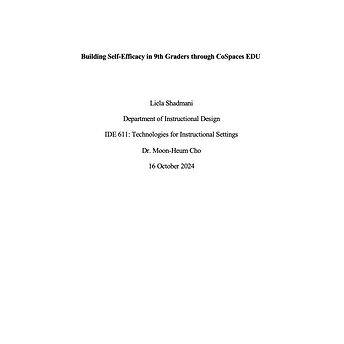
CoSpaces EDU VR Experience: Building Self-Efficacy in 9th Graders
This project built a VR environment where students create, track, and reflect on personal goals. The space integrates puzzles, journaling, and rewards to walk students through the mechanics of self-efficacy, from intention to reflection. So what? This isn't VR for the sake of VR. It’s a learning experience rooted in social-cognitive theory and built around meaningful interaction. The process reveals how immersive tech can support social-emotional learning, giving students agency and reinforcing persistence. For educators, it models how to create tech that’s both engaging and pedagogically sound.
MOOC Reflection: Harvard’s Leaders of Learning
This wasn’t just a passive review. The assignment dissected Harvard’s “Leaders of Learning” MOOC through the lens of instructional effectiveness and personal application. The reflection compared this course to military and academic e-learning formats, highlighting differences in depth, reflection, and engagement. So what? MOOCs are everywhere, but quality varies. This one modeled how high-quality, self-paced courses can push learners to think deeply, apply concepts to real settings, and internalize leadership frameworks. The takeaway is clear—when designed well, MOOCs can shift mindsets and elevate practice, even in rigid environments like the military.
Deliverables
IDE 611 isn’t just another course in instructional technology, it’s where theory met the real world for me. These six deliverables aren’t just assignments. They’re proof that when used intentionally, technology can move the needle on how people learn, grow, and lead. From AI chatbots that coach soldiers through strength training to gamified tools that teach high schoolers about self-efficacy, every project here meets real problems with practical solutions. I tested robotics to simulate battlefield stress, built a virtual makerspace vision board to connect personal growth to leadership goals, and created a VR environment to help 9th graders build confidence, because tech should serve people, not the other way around.
Each artifact reflects a clear instructional purpose, anchored in theory but applied to reality. Whether it’s working within the U.S. Army context or with high school learners, these projects ask the same question: How do we use technology to make learning more relevant, responsive, and human? This portfolio answers that, with strategy, with design, and with heart.